
Siena: Where Medieval Grandeur Meets Timeless Tradition
The Shell-Shaped Heart
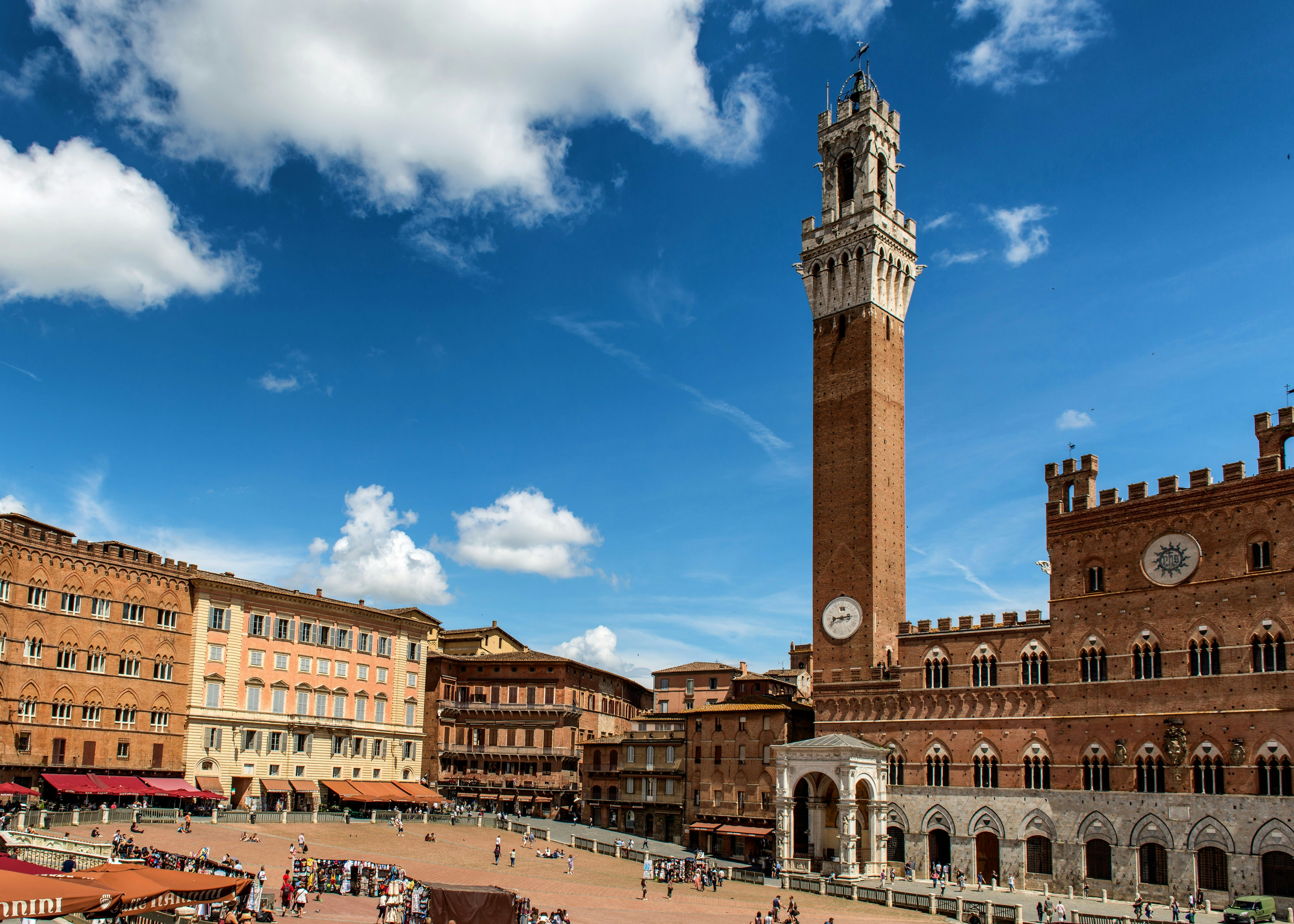
The Piazza del Campo gets recognized worldwide as one of Europe's most extraordinary medieval squares. Its distinctive shell shape—divided into nine sections representing the Council of Nine who governed the city during its golden age—slopes gently downward toward the Palazzo Pubblico. By locals, the piazza gets affectionately called "Il Campo," and its brick-paved surface has been worn smooth by countless footsteps over seven centuries.
Around the edges of this magnificent space, cafes and restaurants occupy buildings whose facades have changed little since the 14th century. Here, visitors can be found savoring morning cappuccinos while pigeons peck at crumbs near the Fonte Gaia, a marble fountain decorated with elaborate carvings. The fountain seen today was created as a 19th-century replica, while the weathered originals get preserved in the museum complex of Santa Maria della Scala.
Twice each summer, the Campo gets transformed into something altogether different. Sand gets spread across the ancient stones, and the famous Palio horse race takes place—a tradition that has been maintained since medieval times. The raw energy and fierce neighborhood rivalries that explode during these brief, chaotic races reveal something essential about this place: beneath its serene medieval beauty, passionate loyalties burn as intensely as they did centuries ago.
Things to do in Siena
Towers That Touch the Sky
The Torre del Mangia rises 102 meters above the Piazza del Campo, and its summit can be reached by those willing to climb 400 narrow steps. The effort gets rewarded with panoramic views that sweep across terracotta rooftops to the surrounding countryside, where vineyards and olive groves paint the hills in varying shades of green and gold. On clear days, distant towns can be spotted dotting the Tuscan landscape, each with its own tower reaching skyward.
The tower's name gets derived from its first bell-ringer, Giovanni di Balduccio, nicknamed "Mangiaguadagni" (profit-eater) for his spendthrift ways. At its base, the Cappella di Piazza was built as a thank-offering after the Black Death finally released its grip on the city in 1348. The plague had claimed nearly two-thirds of the population, yet from this devastation, remarkable artistic achievements would soon emerge.
A Cathedral of Wonders
The Duomo stands as one of Italy's most ambitious religious structures, though it represents merely a fraction of what had been originally envisioned. Plans for a massive expansion—which would have made it one of Christianity's largest churches—were abandoned after the plague decimated both population and resources. The remains of this unrealized dream can still be explored, with massive arches opening onto sky where walls were never completed.
What was finished, however, takes one's breath away. The facade gets adorned with intricate sculptures and mosaics, while the interior floor features 56 panels of marble inlay created by over 40 artists across nearly two centuries. These panels get protected by coverings for much of the year, but during certain periods they get revealed in their full glory—biblical and allegorical scenes rendered in stunning detail.
Below the cathedral, the Cripta gets accessed through a separate entrance. Rediscovered only in 1999 after centuries of being sealed away, its walls burst with vibrant 13th-century frescoes that retain colors so vivid they might have been painted yesterday. The Piccolomini Library, attached to the cathedral, houses Renaissance frescoes by Pinturicchio that depict the life of Pope Pius II with jewel-like brilliance.
The Contrade: Cities Within a City
To truly understand this place, one must grasp the concept of the contrade—the 17 neighborhood districts that divide the historic center. Each contrada possesses its own flag, colors, symbol (ranging from the Eagle to the Porcupine to the She-Wolf), church, and museum. Children born within a contrada's boundaries become members for life, their allegiances passed down through bloodlines like noble titles.
Throughout the medieval streets, the boundaries between contrade get marked by plaques and fountains bearing each district's symbol. Twice yearly, during the Palio races, these neighborhood identities surge to the surface with an intensity that can shock outsiders. The race itself lasts barely 90 seconds, but months of preparation, strategy, and intrigue precede it. Jockeys get hired, horses get blessed in neighborhood churches, and ancient rivalries get rekindled.
The passion surrounding the Palio cannot be overstated. Grown men weep openly when their contrada triumphs; victorious neighborhoods celebrate for days with outdoor feasts where thousands gather at long tables stretching through medieval streets. This wasn't created for tourists—it gets lived by locals as an essential expression of identity and belonging.
Artistic Treasures
The Pinacoteca Nazionale houses one of Italy's finest collections of pre-Renaissance and Renaissance art. Here, works by Duccio, Simone Martini, and the Lorenzetti brothers demonstrate the distinctive Sienese school of painting—characterized by elegant lines, luminous gold backgrounds, and an emotional depth that influenced Italian art for generations.
Duccio's "Maestà," originally created for the cathedral's high altar, was carried through the streets in triumphant procession when completed in 1311. Though now partially dismantled, with sections scattered across various museums, the surviving panels in the Museo dell'Opera del Duomo still radiate extraordinary power. The Virgin's face, rendered with unprecedented emotional nuance for its time, seems to gaze across centuries with timeless compassion.
Throughout the historic center, smaller churches and oratories contain remarkable artworks that in other cities would be centerpiece attractions. The Basilica of San Domenico, with its stark brick exterior, houses the preserved head of Saint Catherine—the city's patron saint, whose mystical visions and political interventions made her one of medieval Europe's most influential figures.
Culinary Traditions
Tuscan cuisine gets celebrated for its simplicity and quality of ingredients, and local trattorias serve dishes that have been prepared the same way for generations. Pici, thick hand-rolled pasta, typically gets served with aglione (a garlic-and-tomato sauce) or cacio e pepe. Pappardelle al cinghiale features wide ribbons of pasta with rich wild boar sauce—the boars that still roam the surrounding forests.
The surrounding countryside produces wines that compete with any in Italy. Brunello di Montalcino, one of the world's most prized red wines, gets produced just a short drive to the south. Closer still, the vineyards of Chianti Classico blanket the hills, their Sangiovese grapes transformed into wines that perfectly complement the region's hearty cuisine.
Panforte, a dense spiced cake packed with nuts and candied fruit, has been made here since the 13th century. Originally created by nuns, this chewy confection gets sold in bakeries throughout the historic center, its recipe largely unchanged across the centuries. Ricciarelli, soft almond cookies dusted with powdered sugar, offer a lighter counterpoint—both make perfect accompaniments to a glass of Vin Santo.
Beyond the Walls
The Tuscan countryside surrounding the city invites exploration. Medieval hilltop villages dot the landscape, each with its own character and treasures. San Gimignano, with its famous tower houses, stands visible from miles away. The thermal baths of Bagno Vignoni, where warm waters have been sought for their healing properties since Roman times, offer relaxation in settings of timeless beauty.
The Val d'Orcia, a UNESCO World Heritage landscape, unfolds in scenes that seem painted rather than real—perfect Renaissance geometry imposed upon rolling hills, with rows of cypress trees leading to isolated farmhouses. This landscape has been captured by countless artists and photographers, yet no image fully conveys the experience of standing amid these hills as evening light turns everything golden.
A Living Museum
What makes this Tuscan gem extraordinary isn't simply its medieval architecture or artistic treasures, though these alone would justify any visit. Rather, it's how seamlessly past and present coexist. The same families that lived here centuries ago still occupy the same buildings. The same festivals get celebrated with undiminished passion. The same recipes get prepared in kitchens that have fed generations.
Walking these streets at dusk, when day-trippers have departed and soft light washes across ancient stones, one can almost hear echoes of all who walked here before—merchants and artists, saints and sinners, dreamers and schemers. The city reveals itself most fully in these quiet moments, when its essential character emerges unchanged by the passage of centuries.
For travelers seeking more beyond Tuscany's hills, the artistic wonders and architectural marvels of Florence await just an hour to the north, where Renaissance genius reached its fullest flowering. Yet many find themselves drawn back to these medieval streets, where time moves differently and traditions remain unbroken threads connecting present to past. Here, in this shell-shaped piazza beneath an ancient tower, something essential about Italian life gets preserved—not as museum piece, but as lived reality.


 Home
Home Wishlist